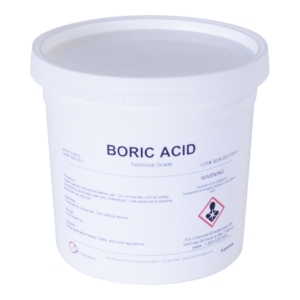
MSDS Number: B3780
Synonyms: ortho-boric acid; boracic acid; borofax, boric acid (h3bo3)
CAS No.: 10043-35-3
Molecular Weight: 61.83
Chemical Formula: h3bo3
Emergency Overview ------------------------------
WARNING! Harmful if swallowed or inhaled. Causes irritation to skin, eyes and respiratory tract. Affects central nervous system, liver and kidneys.
Health Rating: 2 - moderate
Flammability Rating: 0 - none
Reactivity Rating: 0 - none
Contact Rating: 2 - moderate
Lab Protective Equip: goggles; lab coat; vent hood; proper gloves
Storage Color Code: orange (general storage)
------------------------------
Potential Health Effects
Causes irritation to the mucous membranes of the respiratory tract. May be absorbed from the mucous membranes, and depending on the amount of exposure could result in the development of nausea, vomiting, diarrhea, drowsiness, rash, headache, fall in body temperature, low blood pressure, renal injury, cyanosis, coma, and death.
Ingestion: symptoms parallel absorption via inhalation. Adult fatal dose reported at 5 to > 30 grams.
Skin Contact: causes skin irritation. Not significantly absorbed through the intact skin. Readily absorbed through damaged or burned skin. Symptoms of skin absorption parallel inhalation and ingestion.
Eye Contact: causes irritation, redness, and pain.
Chronic Exposure: prolonged absorption causes weight loss, vomiting, diarrhea, skin rash, convulsions and anemia. Liver and particularly the kidneys may be susceptible. Studies of dogs and rats have shown that infertility and damage to testes can result from acute or chronic ingestion of boric acid. Evidence of toxic effects on the human reproductive system is inadequate.
Aggravation of pre-existing conditions: persons with pre-existing skin disorders or eye problems, or impaired liver, kidney or respiratory function may be more susceptible to the effects of the substance.
Inhalation: Remove to fresh air. If not breathing, give artificial respiration. If breathing is difficult, give oxygen. Call a physician.
Ingestion: Induce vomiting immediately as directed by medical personnel. Never give anything by mouth to an unconscious person.
Skin Contact: Remove any contaminated clothing. Wash skin with soap or mild detergent and water for at least 15 minutes. Get medical attention if irritation develops or persists. Wash clothing before re-use.
Eye Contact: Immediately flush eyes with plenty of water for at least 15 minutes, lifting lower and upper eyelids occasionally. Get medical attention immediately.
-
Fire: Not considered to be a fire hazard.
Explosion: A mixture of potassium and boric acid may explode on impact.
Fire extinguishing Media: Use any means suitable for extinguishing surrounding fire.
Special Information: In the event of a fire, wear full protective clothing and NIOSH-approved self-contained breathing apparatus with full facepiece operated in the pressure demand or other positive pressure mode.
Ventilate area of leak or spill. Wear appropriate personal protective equipment as specified in 8.
Spills: pick up and place in a suitable container for reclamation or disposal, using a method that does not generate dust.
Store in closed containers in a cool, dry area. Carbon steel or aluminum containers are suitable for storage. Stainless steel is needed for moist conditions. Use good housekeeping practices to prevent accumulation of dust and follow sound cleaning techniques that will keep airborne particulates at a low level. Wash hands after handling this material. Avoid contact especially when skin is cut or abraided. Containers of this material may be hazardous when empty since they retain product residues (dust, solids); observe all warnings and precautions listed for the product.
Airborne Exposure Limits:
- OSHA permissible exposure limit (pel):
15 mg/m3 total dust, 5 mg/m3 respirable fraction for nuisance dusts.
- ACGIH threshold limit value (TLV):
10 mg/m3 total dust containing no asbestos and < 1% crystalline silica for particulates not otherwise classified (pnoc).
Ventilation System: a system of local and/or general exhaust is recommended to keep employee exposures below the airborne exposure limits. Local exhaust ventilation is generally preferred because it can control the emissions of the contaminant at its source, preventing dispersion of it into the general work area. Please refer to the ACGIH document, industrial ventilation, a manual of recommended practices, most recent edition, for details.
Personal respirators (NIOSH approved): if the exposure limit is exceeded, a half-face dust/mist respirator may be worn for up to ten times the exposure limit or the maximum use concentration specified by the appropriate regulatory agency or respirator supplier, whichever is lowest. A full-face piece dust/mist respirator may be worn up to 50 times the exposure limit, or the maximum use concentration specified by the appropriate regulatory agency, or respirator supplier, whichever is lowest. For emergencies or instances where the exposure levels are not known, use a full-facepiece positive-pressure, air-supplied respirator. Warning: air-purifying respirators do not protect workers in oxygen-deficient atmospheres.
Skin protection: gloves and lab coat, apron or coveralls.
Eye Protection: use chemical safety goggles. Maintain eye wash fountain and quick-drench facilities in work area.
Appearance: white powder or granules.
Odor: odorless.
Solubility: 1g/18ml in cold water.
Density: 1.43
pH: 5.1 Aqueous solution: (0.1M)
% volatiles by volume @ 21c (70f): 0
Boiling Point: decomposes.
Melting Point: 169c (336f)
Vapor Density (air=1): No information found.
Vapor Pressure (mm hg): 2.6 @ 20C (68f)
Evaporation Rate (buac=1): No information found.
Stability: Stable under ordinary conditions of use and storage. If moisture is present, boric acid can be corrosive to iron.
Hazardous Decomposition Products: Loses chemically combined water upon heating, forming Metaboric Acid (hbo2) at 212-221f, then Pyroboric Acid (h2b4o7) at 285-320f, and Boric Anhydride at higher temperatures.
Hazardous Polymerization: Will not occur.
Incompatibilities: Potassium, Ccetic Anhydride, Alkalis, Carbonates, and Hydroxides.
Conditions to Avoid: No information found.
-
Toxicological Data:
- oral rat ld50: 2660 mg/kg;
- oral woman ldlo: 200 mg/kg; investigated as a mutagen, tumorigen, reproductive effector.
Reproductive Toxicity: see chronic health hazards.
| Cancer Lists |
|
NTP Carcinogen |
|
Ingredient
|
Known |
Anticipated |
IARC Category |
----------------------------- |
--------- |
------------ |
------------ |
Boric Acid (10043-53-3) |
No |
No |
None |
Environmental Fate: No information found.
Environmental Toxicity: The ec50/48-hour values for daphnia are over 100 mg/l. This material may be toxic to aquatic life.
-
Whatever cannot be saved for recovery or recycling should be managed in an appropriate and approved waste disposal facility. Processing, use or contamination of this product may change the waste management options. State and local disposal regulations may differ from federal disposal regulations. Dispose of container and unused contents in accordance with federal, state and local requirements.
Not regulated.
| Chemical Inventory Status - Part 1 |
Ingredient
|
TSCA |
EC |
Japan |
Australia |
| ----------------------------- |
--------- |
--------- |
------------ |
------------ |
| Boric Acid (10043-35-3) |
Yes |
Yes |
Yes |
Yes |
| Chemical Inventory Status - Part 2 (Canada) |
Ingredient
|
Korea |
DSL |
NDSL |
Phil. |
| ----------------------------- |
--------- |
--------- |
------------ |
------------ |
| Boric Acid (10043-35-3) |
Yes |
Yes |
No |
Yes |
| Federal, State & International Regulations - Part 1 |
| |
-SARA 302- |
------SARA 313----- |
Ingredient
|
RQ |
TPQ |
LIST |
Chemical Catg . |
| ----------------------------- |
--------- |
--------- |
------------ |
------------ |
| Boric Acid (10043-35-3) |
No |
No |
No |
No |
| Federal, State & International Regulations - Part 2 |
| |
-RCRA- |
-TSCA- |
Ingredient
|
CERCLA |
261.33 |
8 (D) |
| ----------------------------- |
--------- |
------------ |
------------ |
| Boric Acid (10043-35-3) |
No |
No |
No |
Chemical Weapons Convention: no
TSCA 12(b): no
CDTA: no
SARA 311/312:
Acute: yes
Chronic: Yes
Fire: no
Pressure: no
Reactivity: no (pure / solid)
Australian Hazchem Code: No information found.
Poison Schedule: s5
Whmis: this MSDS has been prepared according to the hazard criteria of
the controlled products regulations (cpr) and the MSDS contains
all of the information required by the cpr.
|